
Frequently asked questions
The questions we are asked most often, and our answers.
The most frequent questions
Hironbec
Frequently asked questions about swallows
comments
So many questions come up about swallows. Whether it is about tree swallows or purple martins, people wonder. We invite you to read the many texts that have been published on the subject. If your questions are still unanswered, let us know now.

Tree swallows
Hironbec
Frequently asked questions about tree swallows
Other frequently asked questions
Once the eggs have hatched, it takes 18 to 21 days before the tree swallows leave their nest box. Sometimes the last little one will linger another day or two.
Once the young have flown, they do not come back to the nest, except perhaps the parents, once or twice in the following days. It is a kind of nostalgia for them. After that, there is no more life at the nest box, and it is even a little sad. We will have to wait for the next season, and winter is long in Quebec.
The tree swallows will gather here and there, hunting all day long to rebuild their strength. The juveniles will learn to hunt as well, and to feed themselves. They will build up strength for the long journey. The great departure will stretch from mid-August into September, sometimes even beyond. As for us, we will have to think about other things, while the seasons follow one another once again.
Is it possible to feed
the nestlings when the parents have died?
First of all, you must be quite sure the parents are gone. A little patience can make all the difference.
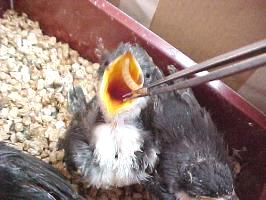
If you absolutely must feed them, then quite a challenge awaits you. It is possible, but difficult. You also need to have the time it requires. It would be better to find a foster home. There are organizations that specialize in this area.
But if you have to feed the babies, do it properly.
If the nestlings are very young, without feathers, they will have to be fed every thirty minutes, perhaps more often. As they grow, they will be able to wait longer. But in reality, what must be remembered is that the nestlings must eat as often as necessary. They should be stuffed with food as long as they want it.
How is it done?
By offering them very fine little balls of ground beef, served at room temperature. Or by offering them mealworms bought at a pet shop in your area. Depending on the size of the nestlings, you may have to cut small portions. Use a toothpick to serve the portions, or else tweezers.
At first you have to help the nestlings open their beaks. It is not always easy. But you should manage it by taking the time it requires.
To give them water, dip the toothpick in water, always at room temperature, and place it near the nestling's beak; the water should flow easily into the beak. Careful, do not drown the nestlings with too much water. Very little at a time.
If the babies do not yet have feathers, they will have to be protected from the cold. A 25-watt bulb can warm them amply, but be careful, the bulb must not be aimed directly at the nestlings, or it will kill them.
Should the nestlings be left in their nest box?
Without parents, the nestlings will not survive alone in the nest box. It is better to house them in a small cardboard box. It will be more practical that way for feeding them. A box that could be closed once the babies begin to flap their wings.
If the nestlings have feathers, the battle is nearly won, and so much the better for the nestlings and for the adoptive parents too, whose task will only be that much less demanding.
When the time comes to fledge, the nestlings will be fed outside the house (taking care to bring them back in right after feeding). One fine day, they will fly off, only to come right back to claim their share of food. They will do this for several days until they become completely independent. It is fascinating.
Do not leave the nestlings alone outside. There are always predators prowling about, such as common grackles, blue jays and often the cats of careless neighbours.
Read Denise Véronneau's experience: post 5, post 6
House sparrow problems!
If house sparrows are present where you live, they may well take over all your nest boxes.
Unless you watch them all the time, their tenacity will defeat all your efforts. Either you trap the sparrows, or you fix a pendulum to the front of the nest box.
The effectiveness of the pendulum has been demonstrated. It is the only known means that allows tree swallows to breed in complete peace.
Does the male incubate the eggs?
In general, it is the female who takes care of incubating the eggs. However, the male lends a hand when the female needs to feed. During this period, the male has more of a lookout role. He will bring food (abundantly) only once the babies are there.
Incubation begins only on the morning the last egg is laid. Sometimes, when visiting the nest box, you can see the pair, lovingly, taking a nap.
Even though the male is known for his tireless devotion to the young babies, he becomes completely helpless if he loses his mate. You will see him land on the nest box a hundred times, sadly, hoping for the return of his sweetheart. As for the babies, they will die of hunger if no one takes charge of them.
The female, on the other hand, will look after her brood alone if she loses her mate.
Is there any hope of a second brood for a male who has lost his mate?
When the season is not too far along, the male often manages to find a second female. You will need to think about cleaning the nest box to welcome the new pair.
Purple martins
Hironbec
Frequently asked questions about purple martins
Gourds
Americans are fond of gourds and they say they get very good results. But in Quebec, we are not yet sold on the idea.
Gourds hang very poorly and the whole thing is not very attractive. A matter of taste, probably.
If the babies are not inclined to jump from the nest at a certain age, they are often unable to get back in (during the first days at least) once they have flown. So they often sleep out under the stars.
It must also be said that in a gourd, the house sparrows or starlings that nest there are harder to catch.
On the other hand, Hironbec has developed huts that play the same role as gourds while being more attractive. A set of these huts forms an interesting and exclusive village.
Where can purple martins be found?
Purple martins are not found throughout Quebec. It is particularly in the St. Lawrence valley that they are most numerous. They are met with mainly along the largest waterways, such as the St. Lawrence River and the Richelieu, Yamaska and Nicolet rivers.
There are two or three existing colonies in Quebec City and on the South Shore, in Lévis. In the 1990s, purple martins were found as far away as Ste-Anne-de-La-Pocatière. Today, it is rarer to see them venture beyond Quebec City.
To learn about their distribution, visit this page.
Arrival of the purple martins
The scouts begin to arrive around mid-April. Purple martins are few in number at that early date. They tend to become more numerous around the martin houses towards the end of April.
The juveniles, on the other hand, arrive much later. They come up from Brazil throughout the month of June. Juveniles have often been seen adopting a martin house as late as June 24.
How long will they take to settle in?
It takes a little patience. In general, these birds take 1 to 3 years before settling into a martin house. Sometimes they will take several years.
Water
It is true that purple martins tend to choose a martin house located near a large body of water. That helps, of course, but it is not an absolute rule. Very often, purple martins decide to establish themselves several kilometres inland.
sparrow-proof
Nest boxes
Hironbec
Frequently asked questions about tree swallow nest boxes
Frequently asked questions
The sparrow-proof pendulum
There is no point in building a nest box that is too big. You would force your swallows to work very hard to furnish it.
The minimum floor dimensions of a tree swallow nest box should be: 4 1/2 in. x 5 or 6 in. (11 X 13 cm).
The height of the entrance above the floor
The height can vary by a few centimetres, but take care that the nest box is not turned into a deadly prison. An entrance too far above the floor could hinder the swallows from getting out. Tree swallows have too often been found dead in the nest box.
If the nest box entrance makes it hard for the birds to get out, add a small wire mesh inside. It will serve as a ladder; a few saw cuts may be enough.
We recommend that the entrance be located between 4 and 6 inches (10 to 15 cm) above the floor. In general, the tree swallow will build her nest by adding enough material to get closer to the exit.
You must avoid cutting an entrance at floor level; predators would soon make off with everything.
The colours and style of the nest box
No one has ever managed to show that colours have any importance whatsoever. The entrance of the nest box must be visible from the air, that is all. One can imagine that a front painted black would be harder to find. Although tree swallows seem to find a woodpecker hole easily enough. A fanciful idea, then? Why not help them a little by making it easier to discover the nest box meant for them.
The shape of the nest box or its style is of no importance, except perhaps the front, in the case where a sparrow-proof pendulum is to be used. In that case, the front must be perpendicular to the base.
The nest box entrance
All the experiments have shown that the entrance must be 1 1/2 inch (3.8 cm) in diameter. No more, no less.
To thwart the sparrow's plans, one is sometimes tempted to reduce the diameter. It is wasted effort; sparrows get in wherever tree swallows are able to nest.
What is more, a 1 1/4 in. entrance could well hold the swallow prisoner. The female especially, as she puts on a little weight before laying.
Tree swallows prefer an easy entrance to one where they have to wear out the tips of their wings to get in. It is out of desperation that they will adopt a smaller entrance.
Between a nest box with a 1 1/2 in. entrance and another with a smaller entrance, the tree swallow will not hesitate to favour the easier entrance. Besides, when they have the choice, they almost always adopt a nest box where there are fewer constraints.
Where to place the nest box
To avoid needless fights between the swallows, it is recommended to put up a single nest box around the house (residential area). Unless it is possible to use the house as a screen. In that case, place one nest box at the front and the other at the back.
Where space allows, nest boxes should be spaced 50 to 100 feet, or 15 to 30 metres, apart.
Orientation of the nest box
East seems a good compromise, but it should not be made into a general rule. We have often seen pairs adopt a nest box regardless of its orientation.
If the nest box is constantly swept by the season's winds (west wind), the birds will appreciate the nest box having its back to the wind.
If, on the other hand, the east side has some building in the bird's flight path, it should perhaps be oriented accordingly, to avoid that obstacle. Birds like the front of the nest box to be free of any obstacle. That makes arrivals at and departures from the nest box easier.
Better still, watch the landing corridor of the tree swallows in your yard and orient the nest box in the same direction. It is almost infallible.
The height of the nest box and its placement
In principle, tree swallows will nest at a height ranging from a few feet to a few dozen feet. It is very often a question of safety. And here again, tree swallows will choose the site that best meets that condition.
The tree swallow nest box must not be fixed just anywhere. The chances of attracting them are better if their needs are taken into account. You must choose a site that is slightly clear of buildings and large trees. Of course they can nest when the nest box is hung on the house. But they often do so when they cannot find any other place available. And as was said earlier, the nest box must rise above the same obstacles in the yard, or at the very least not interfere with the birds' normal routine.
A height of 10 feet seems to suit them. But it must not block occasional access to the nest box. An extendable pole is ideal.
And the house sparrows
It is very difficult to attract tree swallows if the yard is full of house sparrows. It is the sparrows who will take over all the nest boxes. If they do not do it at the start of the season, they will not hesitate to come back on the attack a little later (sparrows have up to 3 broods a season), at the very moment when the tree swallows are busy with their little family. It will be a disaster.
Whatever anyone says, where there are sparrows, you need a pendulum on your nest box. And if the sparrows are there when the first pair of tree swallows shows up, you had better deal with that intruder immediately, before it drives the tree swallows away.
Nest box maintenance
At the end of the season, a week after the young have left, it is time for the big cleaning. A good wash with soapy water will do, followed by a good rinse with clean water. Do not use strong products, such as bleach for example.
If lice or other insects are present in the nest box, sprinkle a little Sevin after washing and let it all dry outside. Then store the nest box away. Avoid storing it inside the house, mainly because of the possible presence of insects.
The sparrow-proof pendulum
Hironbec
Frequently asked questions about the sparrow-proof pendulum
Home
Frequently asked questions
In several regions of Quebec, the presence of house sparrows is a source of frustration for many. As we know, the sparrow competes with both the tree swallow and the eastern bluebird for natural cavities and nest boxes. To keep sparrows from settling in the nest boxes, you can use a tool called a pendulum. It is placed at the front of the nest box in order to limit access to certain bird species.
The pendulum is fitted with an adjustable balance mechanism that can be set off according to the weight of the bird landing at the nest box entrance. A tree swallow weighs between 18 and 24 grams and a house sparrow between 28 and 30 grams. By adjusting the pendulum correctly, you will see that as soon as the sparrow perches, its weight pulls the pendulum down, thus closing the nest box entrance. The swallow, being lighter, does not set the balance off as easily and can therefore enter the nest box freely.
What if the tree swallow hesitates to go through a pendulum? A pendulum is a constraint in itself. It can happen that the tree swallow prefers a nest box where precisely that constraint is absent. To avoid losing this new pair of tree swallows, you simply remove the pendulum, just long enough for the swallows to take possession of the nest box. A few hours are enough. You then put the pendulum back, stiffening it slightly, until the swallow has gone through it once or twice. You then make it sensitive again, always bearing in mind that the sparrows might well take it into their heads to come.
In general, sparrows are more fearful and slower to adjust to the tipping mechanism when it is very sensitive. However, if they are given enough time to practise, they manage to outwit the mechanism. That is why the pendulum must be turned over when a sparrow shows determination to get through it. As far as possible, it must not be allowed to practise. Turned over in this way, the pendulum is absolutely impassable. Once the sparrow is discouraged, it will go away for good. A few hours are enough to discourage it. You then put the pendulum back in position to welcome the tree swallow. But if the pendulum closes the nest box entrance, won't the tree swallow be shut out too? True — except that, at the start of the season, the tree swallow comes to the nest box in the morning and spends only a few minutes there. That leaves ample time to turn the pendulum over to discourage the sparrow.
Is the pendulum really effective?
Yes, truly, if it is used as a tool that one must learn to work with. Since it was created, not a single sparrow has managed to get through a pendulum once the tree swallows have occupied the nest box.
What about the bluebird?
All our experiments show that the bluebird can get through a pendulum. Its capacity to adapt should therefore not be underestimated. However, it is advisable to wait until the eastern bluebirds are well settled before placing a pendulum at the nest box entrance. In general, once the bluebird has finished laying, a pendulum can be hung on the front of the nest box.
What if the tree swallow has difficulty?
When the tree swallow has to try two or three times before getting through a pendulum, all you have to do is stiffen it slightly. Observation is our best guide. You must make sure not to stiffen the pendulum too much; the sparrows are never far away.
Can the sparrow get in if the tree swallows are nesting?
When the nest box is occupied by a pair of tree swallows, or of bluebirds, not a single sparrow will manage to get in. It will never have time to practise before the tree swallows or the bluebirds have quickly driven it off. We all know that birds occupying a nest box defend it fiercely, often at the risk of their lives. The tree swallow's feats in defending her territory are well known. Even the sparrow must flee when she sets to it. Outside the nest box, the tree swallow is queen; she dominates the sparrow by far.
It is when the sparrow can get into the nest box that the tree swallow or the bluebird becomes vulnerable.
What are the factors that contribute to
the success of the pendulum?
1) The weight of the tree swallow is roughly 20 grams, that of the sparrow about 30 grams. As for the eastern bluebird, it weighs slightly more than the sparrow.
2) Another most important factor in the working of the pendulum is the agility of the tree swallow. Her speed in flight is well known, as opposed to the sparrow, which moves about rather clumsily.
3) The third important factor is the swallows' quick adaptation. Note however that the sparrow could just as well succeed if it were allowed to practise.
Must the pendulum stay sensitive throughout the season?
Absolutely, until the young have left. Let us not forget that sparrows have more than three broods a season. They could well come back one fine morning.
Do the tree swallows remember the following year?
Curiously, we have observed several times that tree swallows have an extraordinary memory. They remember the pendulum from one year to the next and there is no longer any need to train them again. You just have to make sure it works properly when it is adjusted to the sensitive point.
Does the pendulum require maintenance?
The pendulum is mounted on a piece of pine wood. Although the wood was dried beforehand, bad weather can cause its weight to vary. That is why the pendulum must never be left outside during the cold season.
Every spring, it is wise to add a drop or two of oil on the bolt on which the pendulum pivots.
Why did they prefer the nest box without a pendulum?
I tried the pendulum experiment. Two nest boxes out of three had a pendulum. There had always been two nest boxes out of three occupied before the pendulums arrived. But only the nest box without a pendulum was chosen. Despite moving the nest boxes with and without pendulums from the front of the house to the back yard, the swallows always preferred the nest box without a pendulum.
That is normal. The pendulum is a constraint in itself. Above all, you must not offer the tree swallows a choice. If you do, you move the pendulum or pendulums onto the occupied nest box or boxes. You will be amazed by your success.
How do the babies get out of a nest box with a pendulum?
Do not be sceptical about the babies getting out. They do it like grown-ups. The babies move gradually forward into the pendulum entrance as they get older. They get used to it from one day to the next, so that when the time comes to leave, they are already accustomed to standing in the entrance. They put their head out and keep their balance, leaving the rest of the body in the nest box entrance. You will see. But, but... the pendulum must always stay in operation for the whole time the brood is there.