
The tree swallow
Tachycineta bicolor — the tenant of backyard nest boxes.
Home
In season, it is not unusual to see a tree swallow perched on a wire or on the clothesline, taking a moment to catch her breath.
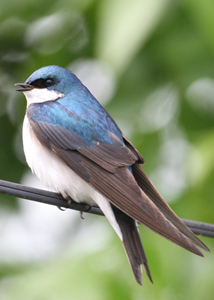
Photo: Gaétan Fortier
She is the first to arrive back to us in the spring, and she is the best known of our swallows. Her back is a dark, iridescent greenish colour and her underside is uniformly white.
The female is duller, but her belly is just as white. She nests from southern Quebec all the way to James Bay.
Usually unwary, the tree swallow is without a doubt the easiest bird to attract to your home. She builds her nest of grass stems and feathers in a suitable nest box hung near the house.
It is true that a tree swallow nest box can be hung at the edge of a window or on the wall of the house. Experience shows, however, that tree swallows settle first where they find safety. And very often, that safety is found right in the middle of the yard. What is more, by gaining height, the nest box will become a coveted site for our favourite species.
She is a very sociable bird that does not fear the presence of people. Unlike other species that turn to seeds when insects are scarce, the tree swallow feeds only on flying insects. She runs into trouble when insects are slow to take flight early in the spring.
It is well known that the tree swallow is surprisingly agile. The suppleness of her flight is remarkable and her speed is simply unbeatable.
Her song is a soft, melodious warble that makes her all the more endearing. As thanks for the welcome we give her, the tree swallow returns to the same nest box year after year.
In the past, the tree swallow nested in tree cavities left by woodpeckers, but today she depends almost entirely on the little houses we make available to her.
The tree swallow nests as a solitary pair. Rarely has more than one pair been seen breeding in the same nest box.