The story of the pendulum
The birth of an idea: how the sparrow-proof pendulum came to be.
Foreword
It all began in 1981
The little story of the pendulum
or the story of a Quebec invention
Chapter 1
It all began in 1981
The little story of the pendulum
or the story of a Quebec invention
01- The birth of an idea,
that is the beginning
First you have to have an idea. And I had none, apart from wanting to stop the sparrows from stealing the places meant for the tree swallows.
I have often wondered how inventors manage to work out a new idea. After all, an idea does not fall from the sky!
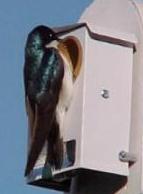
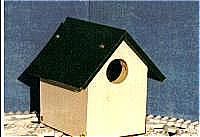
It all began in 1981. I had had enough of seeing my tree swallows killed by the sparrows. So I searched for a long time before this modest idea finally came to me. That small nest box on the right, which I wanted to be miraculous.
Miraculous because it was small. And small because sparrows like wide open spaces. So what do you think? That the sparrows would go elsewhere?
Not at all: they used that nest box as if it had been meant for them. Alas! It was all I could afford at the time.
I first imagined this small nest box.
It was a modest beginning.
Chapter 2
Small nest box or large one, the sparrows saw no difference.
The little story of the pendulum
or the story of a Quebec invention
02- What a fine idea I thought I had had
Several years went by and the sparrows kept on killing my swallows. From one spring to the next I racked my brains looking for the device that would put an end to my springtime nightmares. A few tricks were tried all the same. Here are some of them:
- Lining the inside of the nest box with silver paper. It was claimed that a light-coloured interior drove the sparrows away. That is false. Hanging a weight at the end of a string so that it blocks the entrance of the nest box. It was quite useless: the sparrows went around the string and the tree swallows kept away. Reducing the diameter of the nest box entrance.
First to 1 1/4 inch. The sparrows still managed to get in, and the tree swallows deserted my yard if they found more accessible lodgings.
Then to 1 1/8 in. That was asking too much of the tree swallows and of the sparrows. Both ignored it completely. A 1 1/2 inch entrance is the best solution. Fixing the nest box to the house. It was claimed that sparrows would not be brazen enough to build a nest right under our nose. Oh no, the sparrows fight to occupy the lodging. Waiting until the sparrows' broods are under way before putting up the tree swallows' nest box. That was fine for early spring, but did you know that sparrows raise as many as three (3) broods a season, sometimes four (4)?
When the time comes for a second brood, they destroy the tree swallows' brood in order to move in. Fighting the sparrows day after day, from one morning to the next and all season long. It is a good idea, but it drives anyone who tries it mad.
You have to be fit to walk your yard every day of the week at five in the morning. It takes only a minute for a sparrow to slip into a nest box and kill every occupant. The harm is done the moment your back is turned. Flying warriors, armed with a solid beak and sturdy feet. - Hanging a weight at the end of a string so that it blocks the entrance of the nest box. It was quite useless: the sparrows went around the string and the tree swallows kept away. Reducing the diameter of the nest box entrance.
First to 1 1/4 inch. The sparrows still managed to get in, and the tree swallows deserted my yard if they found more accessible lodgings.
Then to 1 1/8 in. That was asking too much of the tree swallows and of the sparrows. Both ignored it completely. A 1 1/2 inch entrance is the best solution. Fixing the nest box to the house. It was claimed that sparrows would not be brazen enough to build a nest right under our nose. Oh no, the sparrows fight to occupy the lodging. Waiting until the sparrows' broods are under way before putting up the tree swallows' nest box. That was fine for early spring, but did you know that sparrows raise as many as three (3) broods a season, sometimes four (4)?
When the time comes for a second brood, they destroy the tree swallows' brood in order to move in. Fighting the sparrows day after day, from one morning to the next and all season long. It is a good idea, but it drives anyone who tries it mad.
You have to be fit to walk your yard every day of the week at five in the morning. It takes only a minute for a sparrow to slip into a nest box and kill every occupant. The harm is done the moment your back is turned. Flying warriors, armed with a solid beak and sturdy feet. - Reducing the diameter of the nest box entrance.
First to 1 1/4 inch. The sparrows still managed to get in, and the tree swallows deserted my yard if they found more accessible lodgings.
Then to 1 1/8 in. That was asking too much of the tree swallows and of the sparrows. Both ignored it completely. A 1 1/2 inch entrance is the best solution. Fixing the nest box to the house. It was claimed that sparrows would not be brazen enough to build a nest right under our nose. Oh no, the sparrows fight to occupy the lodging. Waiting until the sparrows' broods are under way before putting up the tree swallows' nest box. That was fine for early spring, but did you know that sparrows raise as many as three (3) broods a season, sometimes four (4)?
When the time comes for a second brood, they destroy the tree swallows' brood in order to move in. Fighting the sparrows day after day, from one morning to the next and all season long. It is a good idea, but it drives anyone who tries it mad.
You have to be fit to walk your yard every day of the week at five in the morning. It takes only a minute for a sparrow to slip into a nest box and kill every occupant. The harm is done the moment your back is turned. Flying warriors, armed with a solid beak and sturdy feet. - Fixing the nest box to the house. It was claimed that sparrows would not be brazen enough to build a nest right under our nose. Oh no, the sparrows fight to occupy the lodging. Waiting until the sparrows' broods are under way before putting up the tree swallows' nest box. That was fine for early spring, but did you know that sparrows raise as many as three (3) broods a season, sometimes four (4)?
When the time comes for a second brood, they destroy the tree swallows' brood in order to move in. Fighting the sparrows day after day, from one morning to the next and all season long. It is a good idea, but it drives anyone who tries it mad.
You have to be fit to walk your yard every day of the week at five in the morning. It takes only a minute for a sparrow to slip into a nest box and kill every occupant. The harm is done the moment your back is turned. Flying warriors, armed with a solid beak and sturdy feet. - Waiting until the sparrows' broods are under way before putting up the tree swallows' nest box. That was fine for early spring, but did you know that sparrows raise as many as three (3) broods a season, sometimes four (4)?
When the time comes for a second brood, they destroy the tree swallows' brood in order to move in. Fighting the sparrows day after day, from one morning to the next and all season long. It is a good idea, but it drives anyone who tries it mad.
You have to be fit to walk your yard every day of the week at five in the morning. It takes only a minute for a sparrow to slip into a nest box and kill every occupant. The harm is done the moment your back is turned. Flying warriors, armed with a solid beak and sturdy feet. - Fighting the sparrows day after day, from one morning to the next and all season long. It is a good idea, but it drives anyone who tries it mad.
You have to be fit to walk your yard every day of the week at five in the morning. It takes only a minute for a sparrow to slip into a nest box and kill every occupant. The harm is done the moment your back is turned. Flying warriors, armed with a solid beak and sturdy feet.
Chapter 3
The first sparrow-proof pendulum
The little story of the pendulum
or the story of a Quebec invention
03- Winter 1991
It was during the winter of 1991 that certain ideas came to me. They revolved around the weight of the tree swallow (20 grams), which I set against that of the sparrow (30 grams). The habits of sparrows are not the same as those of tree swallows. It was by picking apart the characteristics of each that the first idea of the pendulum came to me.
I questioned myself at length about the sparrow's behaviour when it eats, when it lands, when it enters the nest box. Its beak too was examined closely, in the way it is used.
In fact, I amused myself by listing the characteristics of the sparrow and setting them against those of the tree swallow.
I wanted to stop the sparrow while protecting the tree swallow. Along this long road, I was struck by the speed of the tree swallow's flight and by the ease with which it plunges into a nest box. Without the shadow of a doubt, the agility of the tree swallow seemed to me an avenue full of promise.
That is when I thought of a pendulum. A thin, rectangular piece of wood hung on the front of the nest box. Once in place, the pendulum can swing to the right and to the left. It has a small ledge on which the sparrow has to land before tipping over with the pendulum.
Surprises!!
The sparrow quickly learned to perch in the middle of that ledge without making it move. It then goes through the pendulum, making light of the ruse.
To outwit it, I then added an off-centre perch just below the entrance. I believed that the sparrow, which likes to perch, would land on it before entering the nest box. It would then tip over without being able to get in.
Alas, the sparrows soon abandoned that unfortunate perch and went straight into the nest box. Oh, these sparrows...!
I then added a second perch that slightly blocked the entrance of the nest box, forcing the bird to land on one perch or the other. That way, I told myself, the sparrow would have no choice but to tip the pendulum.
I soon lost my illusions. After only a few hours of new trials, they learn to land on both perches at once. With their feet spread a little apart, they still manage to slip into the nest box.
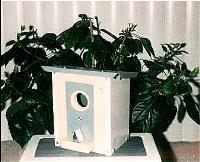
The first sparrow-proof pendulum. The pendulum entrance is in the centre.
Chapter 4
The following spring
The little story of the pendulum
or the story of a Quebec invention
04- I have to find something else
The following spring, in 1992, I had the idea of using the pendulum's hole (1 1/2 in.) as a perch. The sparrow is obliged to go through the pendulum to reach the nest box. As a result, it would set the pendulum turning every time it showed up.
How could it be otherwise? But still, the pendulum entrance had to be off-centre.
Off-centre like that, the sparrow has no choice left. As it lands at the pendulum entrance, the pendulum tips over and so blocks access to the nest box.
In theory the idea is good, but what about in practice?
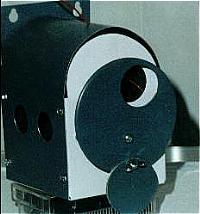
The pendulum is made of aluminium; it swings wonderfully, so much so that the sparrows are unable to get through it. I thought I had won the battle. Alas! The sparrows cannot get in, and neither can the tree swallows.
The pendulum's hole becomes the perch of choice. But it still had to be moved off-centre.
I have to find something else.
Chapter 5
Wood for the tree swallows
The little story of the pendulum
or the story of a Quebec invention
05- Another setback
To make landing easier for the tree swallows, I added a piece of wood under the entrance. That was in 1992. The tree swallows must be able to grip it without difficulty before entering the nest box.
No, that is still not the right solution. I do get a few interesting successes though (the first ones), but nothing really encouraging.
The space between the pendulum and the entrance is empty, and it is probably one of the reasons the tree swallows stay away.
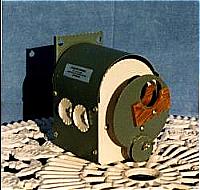
A wooden sill to welcome the swallows, while the pendulum turns to thwart the sparrows.
Chapter 6
It will be a wooden pendulum.
The little story of the pendulum
or the story of a Quebec invention
06- My first successes
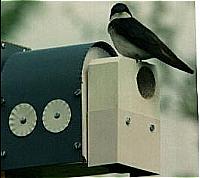
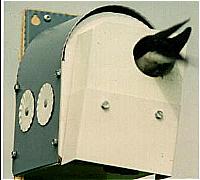
In 1993, Benoit Farley, of St-Basile, gave me the idea of making a pendulum out of wood only, and thick enough to force the sparrow to take a few seconds to go through it, the time needed for the pendulum to tip over.
Result: I obtain my first real successes. However, the turning mechanism remains fragile and the sensitivity is not always dependable.
Chapter 7
Is the sparrow clever?
The little story of the pendulum
or the story of a Quebec invention
07- It is far from over
Just when I thought I had finally found the solution, I discover that the sparrow clings to the pendulum and quickly learns to swing it to the right, then to the left.
In doing so, the sparrow takes advantage of the swing to the left to slip into the pendulum. It thus gains the two seconds it needs to beat the pendulum.
I had to fight back once more by fitting a stop screw on the right of the pendulum. There, I really do think I scored some points.
Although the successes are multiplying, the sensitivity of the pendulum is not always a guarantee of success. The weight of the piece of wood is at issue, as is the lead under the pendulum.
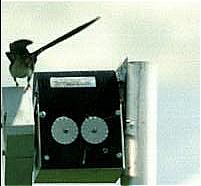
There is no denying the sparrow's ingenuity. It is an admirably resourceful little bird.
Chapter 8
The birth of the nest box with windows
The little story of the pendulum
or the story of a Quebec invention
08- Drying the pendulum
In 1995, I repeat the experiment with windows on the sides, cutting them higher up this time. The first attempt had failed completely. The swallows built their nest and covered the windows (left open during that first season of experiments) entirely with twigs.
But this time, the small windows are left closed during the nesting period. When the babies were 12 or 13 days old, I opened the windows on one side. Surprise! They are completely blocked by wisps of hay. I then see that they are cut a little too low.
At this stage, it is the sensitivity of the pendulum that concerns me most. The pendulum dries out in the July sun and grows heavy in the rain. Its adjustment is called into question.
That is the year the drying of the pendulum begins.
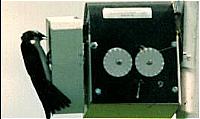
The appearance of the nest box with windows
Chapter 9
The pendulum is refined
The little story of the pendulum
or the story of a Quebec invention
09- To improve the sensitivity
In 1996, I take this photo (below) of the first baby fed through a window. The windows are higher and more practical.
The success was clear. The babies seemed to appreciate all that fresh air.
It is the beginning of a long line of nest boxes with windows. The multibec, as some call it.
To ensure better control of the pendulum's swing, the weight under the pendulum is the subject of a new study. It now slides along a threaded rod.
A reference mark also had to be added on the front of the pendulum. The arrow indicator was born. It is to Guy Beaudoin of Brossard and Paul Favreau of Longueuil that we owe the completion of these last two innovations.
To improve the sensitivity of the pendulum, the weight under each pendulum is now made to match the weight of the piece of wood. That was in 1997. The lead therefore has to be cast taking into account the weight of each piece of wood.
That same year, the ball bearing is replaced by aluminium parts that provide a much more sensitive movement.
First baby photographed in a window.
Chapter 10
From success to success
The little story of the pendulum
or the story of a Quebec invention
10- The crowning of the pendulum
1998. The successes multiply and the many enthusiasts, from every region of Quebec, express their obvious satisfaction.
Hironbec begins to distribute the pendulum outside Quebec.
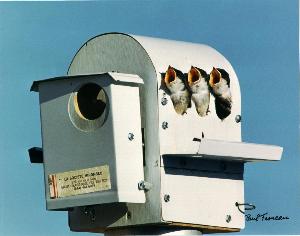
A very fine photo taken by Paul Favreau of Longueuil. It is the crowning of both the pendulum and the windows.
Chapter 11
The pendulum becomes removable
The little story of the pendulum
or the story of a Quebec invention
11- The pendulum makes its entry into the United States
In 1999, the pendulum becomes removable. A single mounting screw holds it to the front of the nest box. It can therefore be taken off at will.
So those who believe that the tree swallow hesitates to go through the pendulum have reason to be pleased.
You need only remove the pendulum for the time it takes the tree swallows to adopt the nest box. A few hours are enough, often only a few minutes. You then put it back.
The same is done with the bluebird.
In 1999, the pendulum makes its entry into the United States and continues to spread across Canada.
Chapter 12
The formula is found at last
The little story of the pendulum
or the story of a Quebec invention
12- That is my little secret
In the fall of 1999, I finally find the formula I was looking for. The formula that gives an identical swing from one pendulum to the next, whatever the variation in the weight of the piece of wood.
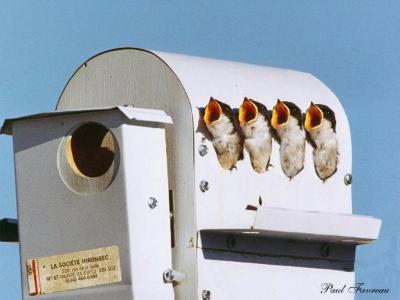
A very fine photo taken by Paul Favreau of Longueuil. It is the crowning of both the pendulum and the windows.
Chapter 13
A success I want to share
The little story of the pendulum
or the story of a Quebec invention
13- We have won
And so the sparrow-proof pendulum was born. It has been a long road, exciting and motivating at once. A gratifying success that grows with each new season, and each time enthusiasts delight in the presence of tree swallows in their yard.
After all these years of experimenting, I can now say that the pendulum is truly the finest tool there is for every tree swallow enthusiast, who no longer has to fight to keep sparrows out of the nest boxes meant for tree swallows and bluebirds.
We have won! It is your turn now.
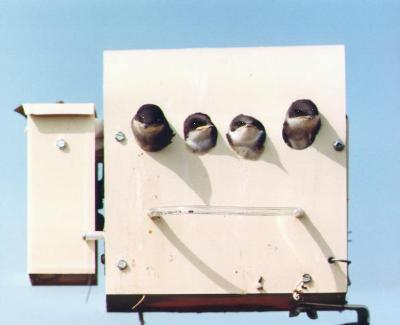
Paul Favreau is the author of this photo of young swallows.
Since the babies were about to fly off, the nest box entrance had to be blocked to give our photographer the time he needed.
The young birds left the nest in the minutes that followed.
Chapter 14
A necessary improvement
The little story of the pendulum
or the story of a Quebec invention
14- Another step

The density of each piece of wood differs from one pendulum to the next, and that meant the lead weight under the pendulum had to match the weight of the wood. Hence the making of lead pieces of different weights.
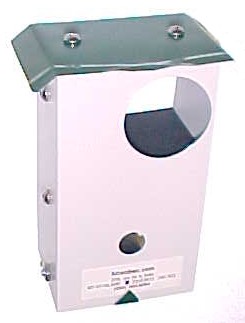
To remedy the situation, the wood had to be taken out of the construction of the pendulum. It was replaced by an aluminium box. A rubber mat was also added in the passage leading to the nest box. In this way, all the pendulums have the same weight, and even the lead weights are now identical.
The new pendulum. It was tested in 2002 and put on the market in 2003. The wooden pendulum is now, of course, a thing of the past.