
The bluebird and the pendulum
Bluebirds in Quebec
Home
The pendulum is an effective tool!
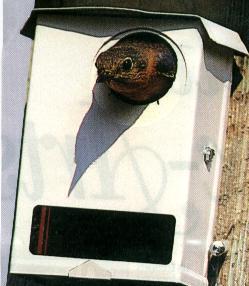
House sparrows
Sparrow-proof pendulum
A pendulum to protect bluebirds
from tree swallows and house sparrows
At the start of every nesting season, the battle for the nest boxes begins without fail. House sparrows and tree swallows take over the homes we intend for bluebirds.
It is a nightmare for enthusiasts, who in turn fight to help bluebirds multiply.
Bluebird enthusiasts usually set up nest boxes in pairs. Tree swallows and bluebirds tolerate one another when they nest close together. It is quite another matter with house sparrows.
The real drama comes when tree swallows or house sparrows decide to move into a box already occupied by bluebirds. The aggressiveness of tree swallows and house sparrows will easily get the better of the bluebirds. Sadly, the brood is often lost, and that means so many fewer bluebirds.
So what can be done? Walk the bluebird trail all day long? That is an idea that would drive even the most persistent enthusiast mad.
Why not simply install a pendulum at the front of the nest box?
True, it would take a great many of them to cover all the boxes offered to bluebirds. There is, however, a solution within everyone's reach.
"You simply hang a pendulum where the bluebirds have decided to settle."
1) The pendulum is a tool for the enthusiast
The pendulum is an effective tool, but you still have to learn how to use it. For bluebirds, it is an obstacle they quickly learn to overcome. Once they have succeeded, they will be permanently safe from house sparrows and tree swallows for the whole season.
2) Adjusting the pendulum
As delivered, the pendulum is set on the arrow mark, calibrated for the weight of a tree swallow. The tree swallow may still need a little help, however, and so may the bluebird. The arrow marks are only a guide.
3) First of all
3.1) The pendulum must be kept immobile during the first day (by turning the weight under the pendulum).
The bluebird will easily learn to pass through it. It will first observe it carefully, cling to it, and finally go through.
Generally, a few minutes are enough. And if you watch the scene, you will be delighted by the agility of your favourites.
3.2) On the second day, the bird's training phase begins. You gradually adjust the pendulum, making it more and more sensitive. In general, two or three adjustments in the same day are enough. You can spread the adjustments over two days if you wish.
In fact, to keep the tree swallow or the house sparrow from taking over a nest box, the pendulum's weight must be brought down to that of a tree swallow (21 grams). To do this, gradually turn the weight under the pendulum until the two arrows meet.
Again, proceed step by step, in two or three stages, over one or two days, depending on your availability. Since tree swallows and house sparrows also have to practise to get through the pendulum, they will not have time to learn before the pair of bluebirds has chased them away.
The bluebirds will thus be protected all season long.
4) If there are eggs or young in the nest box
A pendulum can be added even if the bluebirds are incubating eggs or feeding young.
The procedure is the same as described above. In fact, our first experiments were successful with young in the nest boxes.
Caution
It is very important to leave the pendulum in operation until the young leave the nest; otherwise they would be at the mercy of predators.
Maintenance: Store indoors during the cold season; add a drop of oil every spring.